Digital Product Passport Applications in Electronics, Batteries and Textiles: How CertyPass Makes It Possible
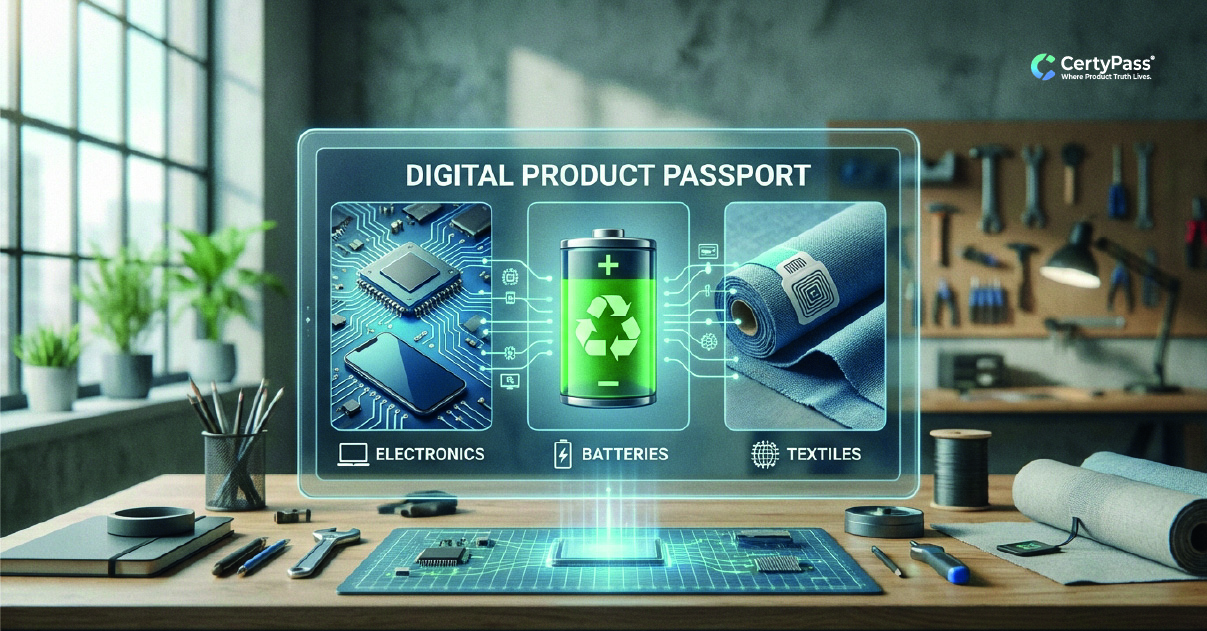
The Digital Product Passport (DPP) will become mandatory in the European Union from 2026 for certain strategic sectors. Its objective is to strengthen traceability, transparency and circularity within the European economy.
Among the first industries impacted are electronics, batteries and the textile sector. All share similar characteristics: complex supply chains, intensive use of critical raw materials, and growing regulatory pressure in terms of sustainability.
In this context, CertyPass provides the infrastructure needed to transform the DPP into an operational, scalable tool aligned with European requirements.
Below, we examine how it can be applied across different sectors.
Electronics: traceability and extended product lifespan
The electronics sector faces challenges related to obsolescence, waste management and the origin of critical materials.
With CertyPass, each device can have a unique digital identity that enables:
- Documentation of the origin of strategic minerals
- Recording of manufacturing processes and environmental footprint
- Maintenance of a verifiable repair and maintenance history
- Facilitation of regulatory audits
For consumers, this means transparency.
For manufacturers and distributors, it ensures control and regulatory compliance.
For regulators, it provides auditable real-time data.
The result is a model that favors repair over replacement and strengthens the circular economy.
Batteries: oversight throughout the energy transition
Batteries, especially those linked to electric mobility and energy storage, require precise traceability due to their environmental and strategic impact.
Through CertyPass, each battery can include a digital passport that records:
- Origin of lithium, nickel or other materials
- Carbon footprint associated with manufacturing
- State of health and charge cycles
- Maintenance history
- Reuse or recycling options
This enables optimized decisions regarding second life, material recovery and compliance with European recycling targets.
The DPP not only improves transparency — it facilitates efficient management of critical resources.
Textiles: transparency in a high-impact industry
The textile sector is one of the largest waste generators globally. The Digital Product Passport aims to promote a more responsible model.
With CertyPass, each garment can integrate a digital identifier including:
- Type of fibers and materials used
- Manufacturing processes
- Recyclability information
- Recommendations to extend product lifespan
This benefits:
- Consumers, who can make informed decisions
- Second-hand platforms, which gain access to verifiable information
- Recyclers, who know the exact composition to separate materials correctly
Digitalizing product information turns sustainability into verifiable data, not just a commercial claim.
Cross-sector benefits of the DPP with CertyPass
Although each sector has its own specificities, there are shared advantages:
- Regulatory compliance aligned with the ESPR
- Increased consumer trust
- Improved internal processes through structured traceability
- Simplified audits
- Competitive advantage in demanding markets
The Digital Product Passport is not merely a regulatory requirement — it is a trust infrastructure.
Challenges and preparation
Implementing the DPP requires:
- Data standardization
- Integration with existing systems
- Cross-department coordination
- Technological scalability
CertyPass has been designed to address these challenges through interoperable, secure and sector-adaptable infrastructure.
Electronics, batteries and textiles are only the beginning. The Digital Product Passport will transform how goods are designed, produced and managed in Europe.
Companies that adopt structured solutions such as CertyPass will not only comply with regulation, but will also be better positioned in an increasingly transparent, digital and circular market.
The industrial future will be traceable, verifiable and sustainable. And it starts now.