The Battery Passport: Data Requirements and Its Impact on Sustainability
Introduction to the Battery Passport
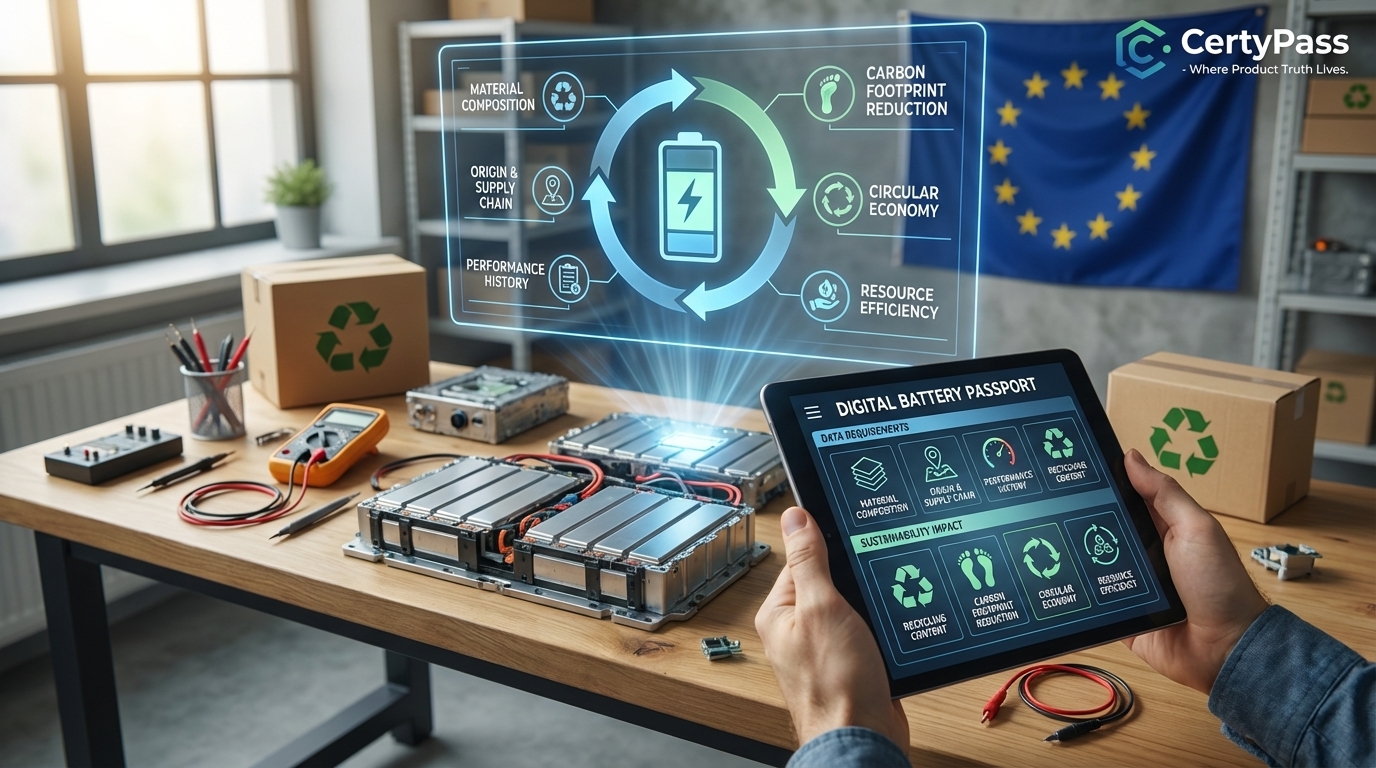
The transition to a circular economy and sustainable electric mobility in the European Union has reached a critical regulatory milestone: the Battery Regulation (EU) 2023/1542. This legislation introduces the concept of the Battery Digital Passport (BDP), an advanced digital tool designed to record and share data regarding the origin, composition, and lifecycle of batteries.
In this context, technological solutions such as CertyPass emerge as essential facilitators, enabling manufacturers and operators to manage this vast amount of information efficiently and securely through blockchain technology and linked QR codes.
Why is this level of detail necessary?
The passport's objective is not merely administrative. It aims to ensure that batteries placed on the European market are safe, durable, and easily recyclable. The digital passport acts as a "digital ID" for the battery, allowing recyclers, repair services, and end consumers to access crucial information that was previously opaque.
Key Data Requirements
According to current regulations, the Battery Digital Passport must include three main categories of information:
1. General Product and Manufacturer Information
This section uniquely identifies the battery and those responsible for it. It includes:
- Unique Identifier: An ID code that links the physical battery to its digital twin.
- Manufacturer Information: Name, registered address, and contact details.
- Battery Type and Model: Technical specifications regarding chemistry and intended use (e.g., LFP, NMC, solid-state).
- Place and Date of Manufacture: Crucial for traceability in case of safety failures.
2. Sustainability and Circularity
This is the core of the European effort to reduce the carbon footprint:
- Carbon Footprint: Declaration of CO2 emissions generated during the lifecycle, from raw material extraction to production.
- Recycled Content: Specific percentages of recovered cobalt, lithium, nickel, and lead used in the manufacturing of the new battery.
- Due Diligence: Information on ethical sourcing of raw materials to prevent human rights abuses in the supply chain.
3. Performance, State of Health (SoH), and Safety
Dynamic technical information that changes over time:
- Rated and Actual Capacity: How much energy it can store.
- State of Charge (SoC) and State of Health (SoH): Critical data to determine if a battery can have a "second life" in stationary energy storage applications.
- Safety Parameters: Temperature limits, voltages, and internal resistance.
The Role of CertyPass and iPass in Data Management
Implementing these data requirements is a massive logistical challenge. CertyPass offers a comprehensive platform to centralize this information. By integrating these systems, companies can:
- Automate data collection from multiple suppliers.
- Ensure data immutability through protected digital records.
- Provide segmented access (consumers see basic information, while recyclers access complex dismantling diagrams).
Conclusion
The Battery Digital Passport is not just a legal obligation; it is a competitive advantage. Companies that early adopt transparency standards and utilize tools like CertyPass will be better positioned in a market that values environmental responsibility above all else. Full traceability is the first step toward a true circular economy in the energy sector.